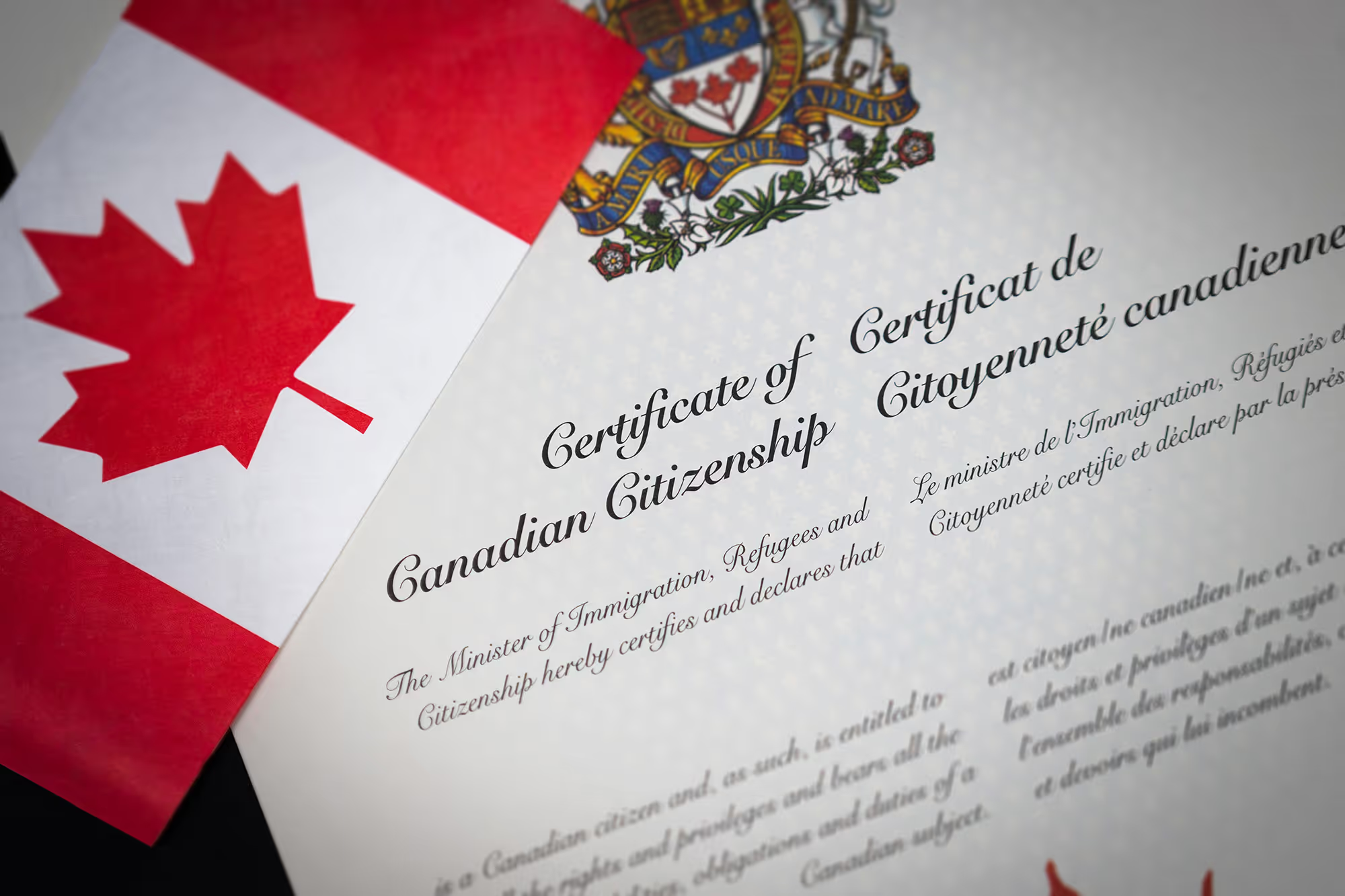
Am I Already Canadian? How Bill C-3 Restores Citizenship by Descent
Updated for the law in force as of December 15, 2025.
If you were born outside Canada and have a Canadian parent, grandparent, or even great-grandparent, there is a real chance you are already a Canadian citizen — and have been since birth — without knowing it.
For years, an outdated rule called the first-generation limit cut thousands of families off from a citizenship they were entitled to. That rule is gone. Under Bill C-3, An Act to amend the Citizenship Act (2025), Canada has restored citizenship by descent beyond the first generation. This is not a future proposal or a policy intention. It is settled law, and people who qualify are recognized as citizens right now.
The hard part is no longer the law. It is proving your place in the family chain with documents that can span several countries and many decades. That is where a licensed immigration lawyer makes the difference.
Not sure if you qualify? Use our free eligibility check or book a consultation with Motivus Law.
The 30-second answer
"Am I a Canadian citizen?" — Why so many people don't realize they are
Most Canadians prove their citizenship with a birth certificate showing they were born in Canada. But citizenship can also pass by descent to children born outside Canada to a Canadian parent.
Between 2009 and December 2025, the law generally allowed citizenship to pass to only one generation born abroad. If your Canadian parent was also born outside Canada, the chain was cut — and you were left out, even though your family was Canadian. These excluded families became known as "Lost Canadians."
Bill C-3 corrects this. The result is that a great many people — by some government estimates hundreds of thousands worldwide — are now recognized as Canadian citizens and simply need to document it.
You may be one of them if any of these sound familiar:
- A parent, grandparent, or great-grandparent was born in Canada (or became a Canadian citizen), and your own family then lived abroad.
- You always heard your family was "originally Canadian" but were told you didn't qualify because the link "skipped a generation."
- You are a U.S. resident with Canadian roots — for example, descendants of Québécois families who moved to the New England mill towns, or Acadian/Cajun lineages.
- A relative looked into this before 2025 and was refused under the old first-generation limit.
If so, the rules that blocked you may no longer apply.
What the first-generation limit was — and why the courts struck it down
Since 2009, Canada's Citizenship Act limited citizenship by descent to the first generation born abroad. A Canadian could pass citizenship to a child born outside Canada only if that parent was born or naturalized in Canada before the child's birth or adoption.
On December 19, 2023, the Ontario Superior Court of Justice ruled that the first-generation limit was unconstitutional. The Government of Canada chose not to appeal, accepting that the law produced unacceptable outcomes for Canadian families. Bill C-3 is Parliament's permanent fix.
Who is now recognized as a Canadian citizen
Bill C-3 works in two directions: it repairs the past retroactively, and it sets clear rules for the future.
If you were born or adopted abroad before December 15, 2025
You are recognized as a Canadian citizen — automatically, from the time of your birth or adoption — if you were previously excluded only by the first-generation limit, and there is a qualifying Canadian ancestor in your direct line. Citizenship can now flow through multiple generations, provided each link in the chain would have been a citizen but for the old rule.
It does not matter whether your parent or grandparent ever claimed or applied for their own citizenship. What matters is whether they would have been a citizen under the law.
If you were born or adopted abroad on or after December 15, 2025
A new, forward-looking rule applies when a Canadian parent who was also born or adopted abroad wants to pass citizenship to a child born abroad. That parent must show a "substantial connection" to Canada — defined as at least 1,095 days (three cumulative years) of physical presence in Canada before the child's birth or adoption.
Parents who were born in Canada or naturalized in Canada still pass citizenship to their children born abroad automatically, with no day-count requirement.
How citizenship flows through the family tree
Bill C-3 recognizes the whole chain of descent for past births, as long as there is an original Qualifying Ancestor — someone who was a Canadian citizen by birth in Canada or by naturalization.
Example 1 — Through a grandparent (the most common case)
- Grandparent: Canadian citizen.
- Parent: Born abroad — was a citizen by descent, but the first-generation limit cut the link to the next generation.
- You: Born abroad, previously excluded.
Result: Because Bill C-3 retroactively cancels the first-generation limit for past births, your parent is treated as having kept their citizenship — so you were born to a Canadian citizen and are recognized as Canadian from birth.
Example 2 — Reaching back to a great-grandparent
- Great-grandparent: Canadian citizen (the anchor).
- Grandparent: Born abroad → now retroactively recognized.
- Parent: Born abroad → now retroactively recognized.
- You: Born abroad → recognized as Canadian from birth.
For births before the law came into force, there is no arbitrary cap on how far back the Qualifying Ancestor can sit, as long as the documentary chain holds together.
Proof of citizenship vs. a grant of citizenship — an important distinction
People recognized under Bill C-3 are not applying for a "grant" of new citizenship. They are applying for proof of a citizenship they already hold.
The distinction matters practically. Under Bill C-3, eligible people hold Canadian citizenship as a matter of law — it attached at birth and has not expired. What you are doing when you "apply" is asking the government to issue paperwork confirming what the law already says about you. The certificate is the evidence; your status exists independently of it. There is no window to miss and no risk of your citizenship lapsing while you gather documents. Once you have the certificate, it unlocks your Canadian passport and the full rights that come with citizenship. One practical note for anyone planning to visit or move to Canada: obtain your citizenship certificate first, then use it to apply for a Canadian passport. Attempting to enter Canada on a foreign passport when you are legally a Canadian citizen can cause delays at the border.
Should you apply on paper or online?
IRCC offers both an online portal and a paper application for proof of citizenship — but for most Bill C-3 claims, the online route may be the wrong choice. The portal was designed for straightforward, single-generation cases and has not been updated to handle the multigenerational histories, adoption scenarios, and Lost Canadian situations that Bill C-3 now covers. When an application falls outside what the system expects, it tends to stall or generate errors rather than flag the case for a human officer. A paper application sidesteps this entirely. It lets you tell your family's story in full, attach the documents that explain each link in the chain, and put the file directly in front of an officer with the context to assess it properly. Unless your case is unusually simple, paper is almost always the better path.
Why work with Motivus Law
Bill C-3 cleared the legal path. The application itself is now an exercise in precise document retrieval and legal interpretation — and that is exactly where claims succeed or fail.
A licensed immigration lawyer reviews your family timeline against the versions of the Citizenship Act that were in force at each ancestor's birth (the 1947 Act, the 1977 Act, and later amendments), confirms that every link in the chain would have been a citizen at the right moment, and resolves complications like name changes, shifting borders, adoptions, and dual-citizenship issues that can otherwise break the chain.
Motivus Law is a Toronto-based firm led by Andrea Prunariu, a dual-licensed immigration lawyer (Law Society of Ontario and the State Bar of California) with over a decade of experience and a high success rate. Andrea immigrated herself, and the firm is built around efficiency, clear communication, and getting complex cases right the first time — so you avoid the costly delays of an incomplete or returned application.
Think you might already be Canadian? Let's confirm it. Book a consultation with Motivus Law.