


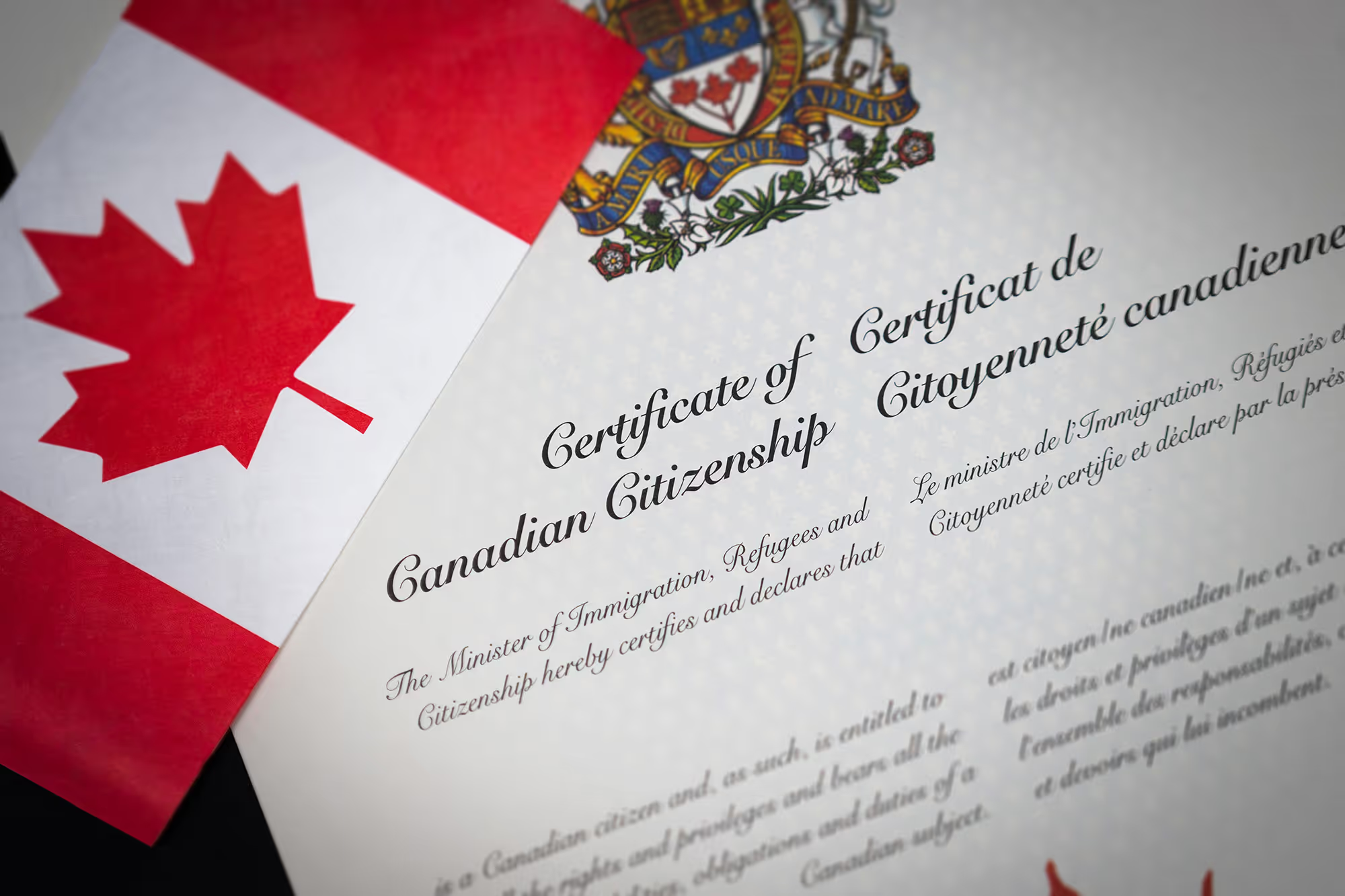
Update — June 30, 2026: IRCC has now completed this review. Of the 100 certificates it initially flagged, 33 were automatically reinstated and 67 — about one per cent of all certificates issued under C-3 — remain outstanding, with IRCC contacting those clients directly and expecting to finish within days. IRCC also acknowledged that its guidance on acceptable documentation "was unclear." For the full breakdown and what it means for your file, read our follow-up: IRCC Has Completed Its Bill C-3 Certificate Review. The original article below reflects the situation as it stood in mid-June 2026.
If you received an email in mid-June asking you to surrender a Canadian citizenship certificate you were only recently granted, you are not alone, and you have not — in all likelihood — lost your citizenship. Around June 13–15, 2026, Immigration, Refugees and Citizenship Canada (IRCC) began emailing people who had been issued certificates of citizenship by descent under Bill C-3, asking them to temporarily surrender those certificates pending a review. The letter, signed by the Registrar of Canadian Citizenship, Peggy Sun, states that the recipient "may not be entitled to hold" the certificate and that it will be returned if the review confirms eligibility.
I want to be precise about what this is, because the headlines have not been. This is not a revocation of citizenship. In most cases the person remains a citizen and the certificate was validly issued; what has been suspended is the proof document, pending re-verification. The Registrar's power to call in or cancel a certificate is distinct from the power to revoke citizenship itself. Those are two different things, and the difference matters enormously to anyone who got one of these notices.
What the notices say, and who got one
To put the scale in context: by late spring 2026, IRCC had issued roughly 4,075 proof-of-citizenship-by-descent certificates, with about half going to applicants born in the United States, according to CBC. Bill C-3 — which removed the first-generation limit on citizenship by descent, received Royal Assent in November 2025, and came into force on December 15, 2025 — opened the door to a great many people. Parliament's Budget Officer estimated that up to roughly 115,000 people could become newly eligible.
So when you read that "millions of Americans may now be Canadian," there is real truth in it. The first-generation limit was the wall, and C-3 took it down. They do qualify if they have a Canadian ancestor. But that headline is true and incomplete at the same time, and the gap it leaves out is exactly what these surrender notices are about.
One thing worth stating plainly: as of now, there is no standalone IRCC policy bulletin announcing these suspensions. What we know comes from the case letters themselves, from CBC's reporting, from lawyer commentary, and from indirect IRCC acknowledgement — not from a published directive. Anyone telling you they know precisely how many notices went out, or exactly how this resolves, is working from the same incomplete picture I am.
My read: this is the proof gap surfacing
Here is the lens I would apply to the whole event. The certificates are not being suspended because the law changed back, or because anyone's entitlement evaporated. They are being suspended because IRCC is re-examining whether the documentary record actually proved the entitlement in the first place.
That distinction is the heart of this area of law. The real story in citizenship by descent has never been eligibility — it is the gap between technical eligibility and practical proof. They do qualify if they have a Canadian ancestor. The challenge is that the older that lineage goes, the further back it reaches, the more difficult it becomes to obtain proof of citizenship. C-3 widened who is eligible; it did nothing to make the older records easier to find. The surrender notices are that proof gap surfacing in a very public way.
Why some files are more exposed than others
Not every file is equally vulnerable to a second look. A few patterns are predictably more exposed.
The first is a file that leans on third-party genealogy records — Ancestry, FamilySearch — as its primary evidence. IRCC has specifically come out to say it will not accept solely third-party records; some of that material may still be included as corroborating evidence, but not as the spine of the proof. There is a real irony here, because the government partners with these very sites, and yet will not treat their records as primary proof of entitlement. A file built on that foundation is exactly the kind that struggles to survive re-verification.
The second is depth. The further back the lineage runs, the thinner the records get. Once you are working in the early 1800s or the late 1700s, primary documentation genuinely becomes harder to assemble, and a chain that was difficult to complete the first time is difficult to defend the second.
The third is Québec. Québec files are their own animal: baptismal records generally must come as certified reproductions from Bibliothèque et Archives nationales du Québec — BAnQ — and obtaining them takes months. In my experience, that is the most common bottleneck, and it is worth anticipating well before it becomes urgent.
What IRCC is actually asking for
The theme running through these letters is "original source authority." IRCC wants supporting documents obtained from the original authority — the civil registry, the vital-statistics office, the archive — for each generation in the chain. A defensible file is built from certified records issued by the original authority at every link: birth certificates first, and where those are missing, the next-best primary records from that same original authority — hospital, baptismal, census, boat-manifest, voting-roll, or tax records.
Where an original document genuinely cannot be obtained, the expectation is a written explanation together with evidence of the attempts you made to get it. That is a reasonable standard, and it is also a stricter one than many applicants assumed when they filed. IRCC's own guidance is explicit that an application cannot be supported solely by third-party records — the genealogy-site scans many applicants leaned on — and that the proof for each generation must come from the original issuing authority.
If you received a surrender notice
Do not ignore it, and do not panic. The letter is not a final decision; it is the opening of a review, and a review is contestable. The sensible path is to have the file looked at properly before you respond — to understand which generation in your chain IRCC is questioning and whether your documentation answers it from the original authority. If it does, that is the case you make. If it has a gap, it is better to know precisely where the gap is than to respond blind.
I would also be cautious of anyone promising a guaranteed outcome on a matter this unsettled. There is no published policy yet, and confident promises about how these reviews will land are not grounded in anything you can hold IRCC to.
If you are about to file
If you are eligible and have not yet applied, this moment is an argument for getting the document chain right before you file rather than rushing it in. An incomplete chain invites a request for further evidence or a rejection — and given the backlog, that is a costly place to land. The processing time for proof of citizenship has now stretched to roughly 15 months, with about 82,000 people in the queue. A file that has to be corrected and resubmitted does not just lose your place; it sends you to the back of a much longer line than the one you started in.
None of this changes the underlying entitlement. If you have a Canadian ancestor, you qualify. The work — the part the headlines skip — is proving it, generation by generation, from the original authority. That is what these notices are really testing.
If you've received a surrender notice, or you want your document chain reviewed before you file under Bill C-3, book a consultation with our team.